Skinny to strong
Skinny guy workout plan: train 3 days, eat a little more, beat your log
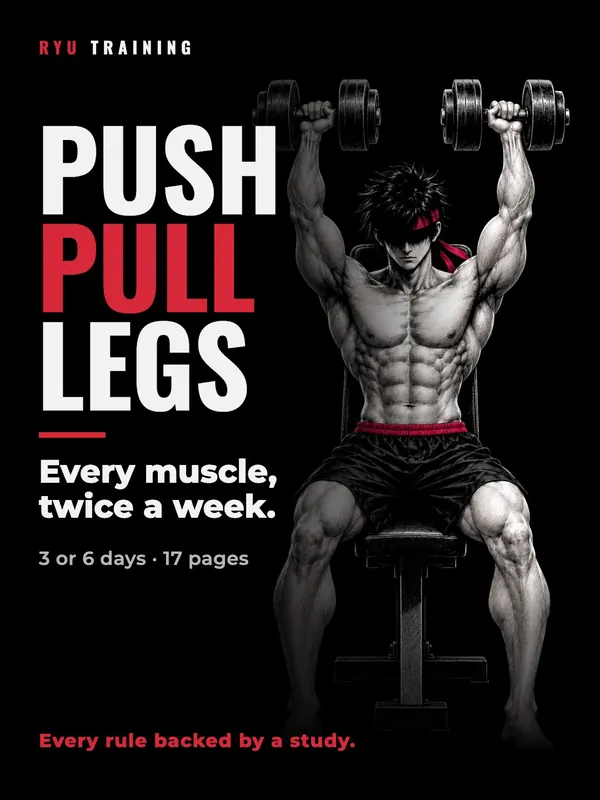
A skinny guy workout plan needs three things: hard sets on 3 days a week, a little more food than you burn, and enough protein. Our 3-day push pull legs plan covers the training. On food, a larger surplus mainly added fat in one study [Helms et al. 2023], and protein above about 1.6 g per kg a day gave no further lean-mass gain [Morton et al. 2018].
Last updated · By Ryu Training, published by Badr Zinoun · How we wrote this
What should a skinny guy workout plan include?
Training, food and patience, each with a rule a study supports. The table sums up the plan; the sections below explain each line.
| Part | What to do | Why |
|---|---|---|
| Days | 3 a week: Push on Monday, Pull on Wednesday, Legs on Friday (Push Pull Legs, option A) | With equal weekly sets, 1, 2 or 3+ sessions per muscle gave similar growth [Schoenfeld et al. 2019] |
| Sets | 3 to 8 hard sets per muscle per week to start, 6 to 16 later (option B) | More weekly sets, more growth, with diminishing returns [Pelland et al. 2026] |
| Effort | Stop 1–2 reps short of failure (RIR 1–2) | Grew muscle as well as going to failure [Refalo et al. 2024] |
| Reps | About 6–10 on big lifts, 10–20 on small ones | Light and heavy loads near failure built similar muscle; heavy loads built more strength [Schoenfeld et al. 2017] |
| Rest | 2–3 minutes on big lifts, 1–2 on small ones | 3 minutes beat 1 minute for strength and thigh size [Schoenfeld et al. 2016] |
| Progress | Add reps, then weight | Adding reps worked as well as adding weight [Plotkin et al. 2022] |
| Food | A little more than you burn, not a lot more | A bigger surplus mainly added fat [Helms et al. 2023] |
| Protein | About 1.6 g per kg of body weight a day | No further lean-mass gain above that [Morton et al. 2018] |
How many days a week should a skinny guy train?
Three is enough to start. With the weekly sets equal, training a muscle once, twice or three or more times a week gave similar growth [Schoenfeld et al. 2019]. Our Push Pull Legs option A trains each muscle once a week in three sessions of about an hour.
Move to 6 days (option B, the same sessions twice) once you've trained for 8 weeks without missing a session. It doubles your weekly sets, and more sets meant more growth, with diminishing returns [Pelland et al. 2026]. Other splits work too: see the best workout split comparison.
Does a skinny guy need to lift heavy?
Not to build muscle. Across 21 studies, light and heavy loads taken close to failure built similar muscle, and heavy loads built more maximal strength [Schoenfeld et al. 2017]. That is why our programs keep the big lifts at about 6–10 reps and the small ones at 10–20.
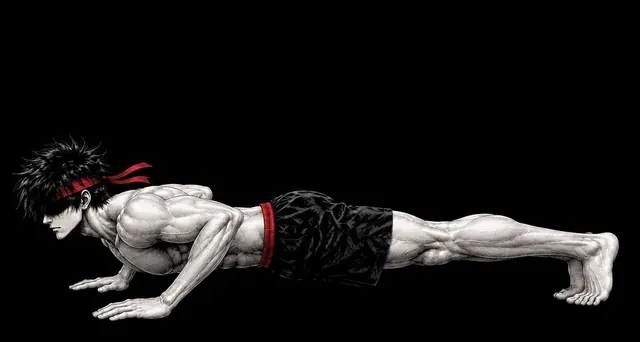
At home, bodyweight works: in 18 untrained men, push-ups taken near failure grew the chest +22% against +26% for a light bench press over 8 weeks [Kikuchi & Nakazato 2017]. Every exercise in our programs has a home version.
How does a skinny guy keep making progress?
Beat your training log. Keep the weight until you reach the top of the rep range on every set, then add the smallest step; adding reps at the same weight worked as well as adding weight [Plotkin et al. 2022].
Our programs add an easy week (half the sets) every 6–8 weeks. In one study, even a full week off in the middle of a 9-week program did not change lower-body muscle growth, and strength gains were a little smaller [Coleman et al. 2024].
How much should a skinny guy eat to build muscle?
A little more than you burn, but nobody knows the exact number. A 2019 review found that an energy surplus supports muscle gain, but that the surplus that maximizes it is unknown and common estimates were never validated in lifters [Slater et al. 2019].
Bigger is not better. In 21 lifters followed for 8 weeks at maintenance, +5% or +15% calories, faster weight gain mainly added fat rather than muscle thickness, though bench press strength rose more with +15% [Helms et al. 2023]. Only 17 finished, so take it as a direction, not a rule.
In practice: eat a bit more than you do now, and check your weight and your training log every few weeks. If you have a health condition or a history of eating problems, talk to a doctor or a registered dietitian before you change how you eat.
How much protein does a skinny guy need?
About 1.6 g per kg of body weight a day, or about 0.7 g per pound. In a meta-analysis of 49 studies with 1,863 people, protein supplements added a little to the strength and lean mass gained from training, and total protein intakes above about 1.6 g per kg a day gave no further gain in lean mass [Morton et al. 2018].
| Body weight | Protein per day |
|---|---|
| 55 kg (121 lb) | About 89 g |
| 60 kg (132 lb) | About 97 g |
| 65 kg (143 lb) | About 105 g |
| 70 kg (154 lb) | About 113 g |
That total counts every source: meals and any shake. A shake is a convenience, not a requirement.
Safety
Before you start
This is general fitness information, not medical advice. If you have pain, an injury or a health condition, check with a doctor or physical therapist first, and stop any exercise that hurts.
Under 18? Strength training is safe and worthwhile for teens when it is supervised and taught properly; most reported injuries came from poor technique, wrong loads or no supervision [Faigenbaum & Myer 2010] [Lloyd et al. 2014]. Learn the lifts with a coach, a PE teacher or an adult who knows them. Light weights first, no max lifts, never heavy weights over your head alone.
Questions people ask
How long does it take a skinny guy to build muscle?
There is no honest single number. On the same 12-week arm program, biceps size changed anywhere from −2% to +59% between people [Hubal et al. 2005]. Compare your log and your measurements month to month, not with someone else.
Can a skinny guy build muscle at home?
Yes. In 18 untrained men, push-ups taken near failure grew the chest +22%, close to a light bench press at +26% [Kikuchi & Nakazato 2017]. Every exercise in our programs has a home version with a backpack, bands, a pull-up bar, a chair and a step.
Do I need protein shakes?
No. A shake is one way to reach your daily total. In a meta-analysis of 49 studies, total protein intakes above about 1.6 g per kg of body weight a day gave no further gain in lean mass [Morton et al. 2018].
Should a skinny guy train to failure?
Not on every set. Stopping 1–2 reps short of failure grew the quads as much as training to failure in 18 trained lifters over 8 weeks [Refalo et al. 2024].