What is an upper lower split?
Four sessions a week: two upper-body days and two lower-body days. Day A and day B use different exercises, so each muscle is trained twice a week from two angles.
Is a 4-day upper lower split good for beginners?
Yes, if you can give it 4 days a week. It suits people who have trained for a few months, and beginners who can commit to 4 sessions. If you can only train 2 or 3 days a week, take the Push / Pull / Legs plan, option A.
Is training each muscle twice a week better than once?
An early meta-analysis found that twice a week beat once a week [Schoenfeld et al. 2016]. Later work showed that when the weekly sets are equal, frequency matters little: the total number of hard sets does the work [Schoenfeld et al. 2019] [Pelland et al. 2026]. An upper lower split gives you twice-a-week training and enough sets in only 4 sessions.
Which days should I train?
Monday Upper A, Tuesday Lower A, Wednesday rest, Thursday Upper B, Friday Lower B, weekend off. Never put the two lower days back to back. If you miss a session, do it the next day and shift the week.
How long is each session?
Upper A and Upper B take 55–65 minutes, Lower A 50–60 minutes and Lower B 45–55 minutes, rest between sets included.
Can I do this program at home?
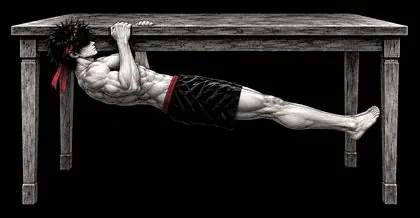
Yes. Every exercise has a home version that needs a backpack you can load with books or water bottles, two resistance bands, a doorway pull-up bar, a sturdy chair and a step. For example, push-ups replace the bench press and Nordic curls replace the leg curl machine.
What does RIR mean?
Reps in reserve: how many more clean reps you could still do when you stop the set. RIR 1–2 means you stop when you feel you have 1 or 2 reps left. In one 8-week study, stopping 1–2 reps short of failure grew the quads as much as going to failure [Refalo et al. 2024].