RYUTRAINING

Train like your favorite hero

Anime workouts you can actually follow

Anime training arcs are fun to watch and hard to copy: a drawn hero can do a thousand reps a day and never stall. Each page below starts from what the series actually shows, checks it against published studies, and ends with a program a real beginner can follow, at home or at the gym.

Updated 2026-10-24 · by Ryu Training

Close-up of Ryu, the Ryu Training manga character, crimson headband, eyes in the shadow of his hair

Pick your hero

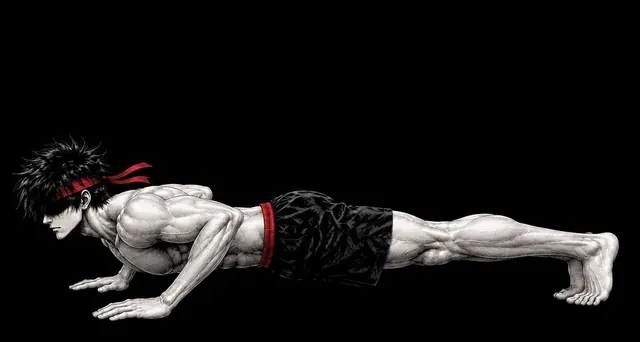
  • Ryu, the channel's manga character, at the bottom of a push-up, chest close to the floor

    Saitama workout

    Saitama's workout from One-Punch Man, with sources: 100 push-ups, sit-ups and squats plus a 10 km run. What studies say, and a plan you can follow.
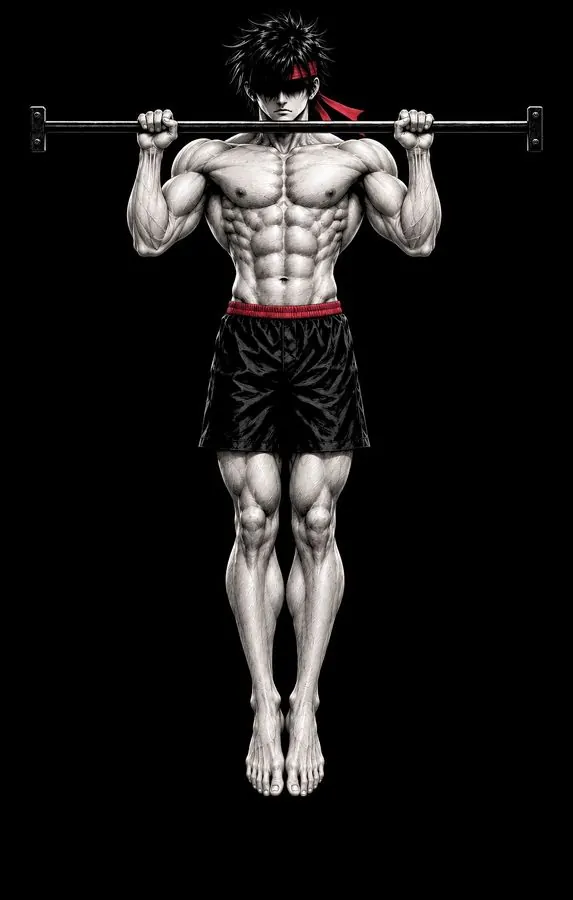
  • Ryu, the channel's manga character, at the top of a pull-up, chin above the bar

    Baki workout

    A Baki workout you can actually follow: what we could and couldn't source from the manga, what studies say, and a 3-day program for home or gym.

All drawings show Ryu, the channel's own AI-drawn character. They are not official anime or manga artwork.

How to turn any anime training arc into a real plan

  1. Count hard sets, not reps

    Muscle growth follows the number of hard sets you do each week, with diminishing returns [Schoenfeld et al. 2017] [Pelland et al. 2026]. A hundred easy reps are not a hundred hard ones.

  2. Get close to failure, not past it

    Growth tended to rise as sets ended closer to failure [Robinson et al. 2024], but going all the way to failure didn't add more muscle than stopping 1–2 reps short [Refalo et al. 2023].

  3. You don't need to train every day

    With the same weekly sets, training a muscle 1, 2 or 3+ times a week gave similar growth [Schoenfeld et al. 2019]. Daily training is a schedule choice, not a requirement.

  4. Make it harder over time

    Adding reps at the same weight worked as well as adding weight [Plotkin et al. 2022]. At home, that means more reps, a heavier backpack or a harder version of the move.

  5. Your body is not a drawing

    In a study of 585 adults doing the same 12-week arm program, biceps size changed anywhere from −2% to +59% [Hubal et al. 2005]. Compare yourself with last month, not with a character.

Want a full program instead?

The three free programs (Push Pull Legs, Upper / Lower, 5-Day Split) apply the same rules over 3 to 6 days a week, with a PDF for each.

See the free programs

Questions people ask

Do anime workouts actually work?

The routines shown in anime are written for a story, not tested. The parts that match the research do work: hard sets taken close to failure, enough of them each week, and steady progress [Schoenfeld et al. 2017] [Refalo et al. 2023] [Plotkin et al. 2022]. Each page here turns an anime routine into a plan built on those rules.

Can I get a body like an anime character?

Nobody can promise that. People respond very differently to the same training: in one study of 585 adults, biceps size changed from −2% to +59% after the same 12-week program [Hubal et al. 2005]. Train well and measure your own progress.

Are these workouts safe for teenagers?

Strength training is safe and worthwhile for teens when it is supervised and taught properly; most reported injuries came from poor technique, wrong loads or no supervision [Faigenbaum & Myer 2010] [Lloyd et al. 2014]. Learn the moves with a coach, a PE teacher or an adult who knows them, start light and never lift heavy overhead alone.

Are the drawings official anime art?

No. Every drawing on this site shows Ryu, the channel's own character, drawn with AI. Character names are used only to say which series a page talks about.

References

Every study below was checked on PubMed. Results in short, as the studies report them; most were done on young adults, often beginners.

  1. Faigenbaum AD, Myer GD (2010). Resistance training among young athletes: safety, efficacy and injury prevention effects. Br J Sports Med. PMID 19945973.Review: strength training is safe and worthwhile for teens when it is supervised and taught properly; most reported injuries came from poor technique, wrong loads or no supervision.
  2. Hubal MJ et al. (2005). Variability in muscle size and strength gain after unilateral resistance training. Med Sci Sports Exerc. PMID 15947721.585 adults, the same 12-week arm program: biceps size changed anywhere from -2% to +59%.
  3. Lloyd RS et al. (2014). Position statement on youth resistance training: the 2014 International Consensus. Br J Sports Med. PMID 24055781.International consensus, endorsed by sports-medicine and paediatric organisations, on how young people should strength train.
  4. Pelland JC et al. (2026). The Resistance Training Dose Response: Meta-Regressions Exploring the Effects of Weekly Volume and Frequency. Sports Med. PMID 41343037.67 studies, 2,058 people: more weekly sets meant more growth, with diminishing returns. Training a muscle more often added strength, but its effect on size was compatible with zero.
  5. Plotkin D et al. (2022). Progressive overload without progressing load? The effects of load or repetition progression on muscular adaptations. PeerJ. PMID 36199287.43 trained people, 8 weeks: adding reps at the same weight worked as well as adding weight.
  6. Refalo MC et al. (2023). Influence of Resistance Training Proximity-to-Failure on Skeletal Muscle Hypertrophy. Sports Med. PMID 36334240.Meta-analysis of 15 studies: no clear extra growth from going all the way to failure.
  7. Robinson ZP et al. (2024). Exploring the Dose-Response Relationship Between Estimated Resistance Training Proximity to Failure, Strength Gain, and Muscle Hypertrophy. Sports Med. PMID 38970765.Meta-regression: muscle growth tended to rise as sets ended closer to failure (exploratory).
  8. Schoenfeld BJ et al. (2017). Dose-response relationship between weekly resistance training volume and increases in muscle mass. J Sports Sci. PMID 27433992.15 studies: each extra weekly set was linked to about 0.37% more muscle growth.
  9. Schoenfeld BJ et al. (2019). How many times per week should a muscle be trained to maximize muscle hypertrophy?. J Sports Sci. PMID 30558493.25 studies: with the same weekly sets, training a muscle 1, 2 or 3+ times a week gave similar growth.