RYUTRAINING

Anime workout

Saitama workout: train like One Punch Man, for real

In One-Punch Man, Saitama says his strength comes from 100 push-ups, 100 sit-ups, 100 squats and a 10 km run, every day, for three years. As a habit it beats doing nothing. As a muscle-building plan it has gaps: nobody has tested it, there is no pulling exercise, and once 100 reps feel easy most of them stop being hard sets. Below: the exact source, what the studies say, and a version that keeps the spirit and fixes the gaps.

Updated 2026-10-24 · by Ryu Training

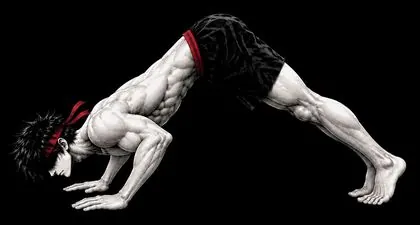
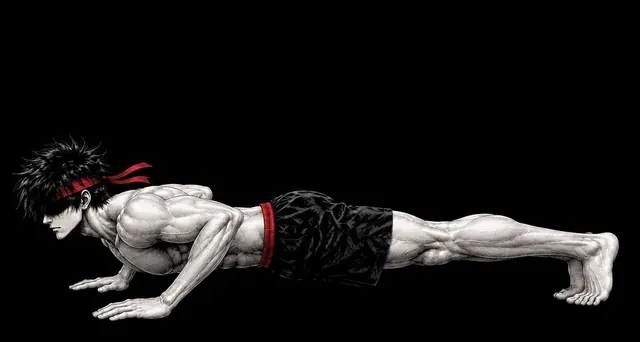
Ryu, the channel's manga character, at the bottom of a push-up, chest close to the floor

What Saitama's routine is in One-Punch Man

Saitama, the hero of One-Punch Man, explains his training in the chapter "The Secret to Strength": every day, 100 push-ups, 100 sit-ups, 100 squats and a 10 km run, plus eating properly and never using the air conditioner or the heater, to strengthen his mind.

He says he kept it up for three years. Genos, who asked for his secret, doesn't believe him.

Sources

  • MangaOne-Punch Man (story by ONE, art by Yusuke Murata), Punch 11, "The Secret to Strength", in Volume 2 (Shueisha, 2012; English edition VIZ Media, 2015).
  • AnimeOne-Punch Man, season 1, episode 3, "The Obsessive Scientist" (first aired in Japan in October 2015).

Character and series names are used only to say what this page is about. Ryu Training is not affiliated with their authors or publishers, and every drawing here shows Ryu, the channel's own character.

What the studies say about Saitama's workout

  1. Nobody has studied this routine

    We found no study of 100 push-ups, sit-ups and squats a day. What studies do measure is the work behind it: weekly hard sets, how close each set ends to failure, and progression.

  2. Push-ups can build the chest

    In an 8-week study, push-ups taken near failure grew the chest +22% and the triceps +10.5%, close to a light bench press [Kikuchi & Nakazato 2017]. So push-ups are a good base, as long as they stay hard.

  3. 100 easy reps are not 100 hard reps

    Growth tended to rise as sets ended closer to failure [Robinson et al. 2024], and stopping 1–2 reps short worked as well as failing [Refalo et al. 2023]. Once 100 push-ups are easy, most of those reps are far from failure. Fewer sets of a harder version do more.

  4. Every day is optional

    With the same weekly sets, training a muscle 1, 2 or 3+ times a week gave similar growth [Schoenfeld et al. 2019]. More weekly sets meant more growth, with diminishing returns [Pelland et al. 2026]. Three hard sessions a week can do the job of seven easy ones.

  5. Squat deep

    Full squats grew the glutes +6.7% versus +2.2% for half squats over 10 weeks [Kubo et al. 2019]. If you squat like Saitama, go all the way down.

  6. No pulling, and the parts we don't cover

    The routine has no exercise for the back or biceps, so the plan below adds rows. Our study list has nothing on sit-ups or on the 10 km run, so this page makes no claim about them.

A Saitama workout you can follow

Same spirit: bodyweight, at home, no excuses. Three full-body sessions a week, each set taken to 1–2 reps from failure, and a harder version of each move as you get stronger. It needs a backpack you can load with books or water bottles, a sturdy table, a chair and a step.

When: Monday, Wednesday, Friday (or any 3 days with a rest day between them).

The session

Chest · Legs · Back · Shoulders · Calves · 18 hard sets · 45–55 min

The session: Chest · Legs · Back · Shoulders · Calves, 18 hard sets, 45–55 min
ExerciseSets × repsRestRIR
Push-Up
Home: Easier: incline push-up
4 × 8–201–2 min1–2
Squat
Home: Backpack goblet squat
4 × 8–152 min1–2
Inverted Row
Home: Table row
3 × 8–152 min1–2
Romanian Deadlift
Home: Backpack Romanian deadlift
3 × 8–122 min2
Seated Dumbbell Shoulder Press
Home: Pike push-up
2 × 6–122 min1–2
Standing Calf Raise
Home: One-leg calf raise on a step
2 × 10–151 min0–1
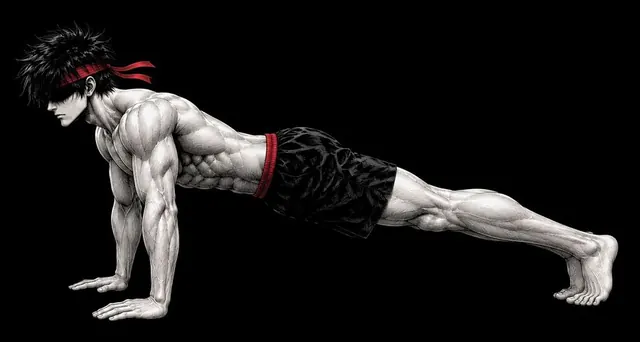
  1. Ryu at the top of a push-up, arms straight and body in one line
    Start
    Ryu at the bottom of a push-up, chest close to the floor
    Finish

    01 · Chest · Triceps · Front delts

    Push-Up

    floor, table or chair version

    • 4 × 8–20sets × reps
    • 1–2 minrest
    • RIR 1–2reps in reserve
    • Hands a bit wider than your shoulders, body straight from head to heels.
    • Chest to a fist from the floor, elbows about 45° from your body.
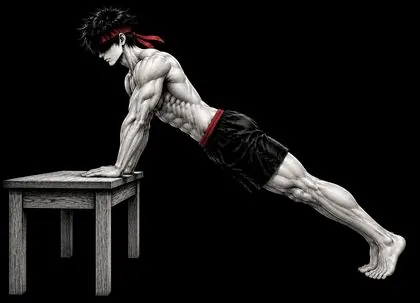
    Ryu doing an incline push-up with his hands on a table

    HomeEasier: incline push-up. Hands on a table. Harder: feet on a chair.

    Study: In 8 weeks, push-ups grew the chest +22% and the triceps +10.5%. [Kikuchi & Nakazato 2017]

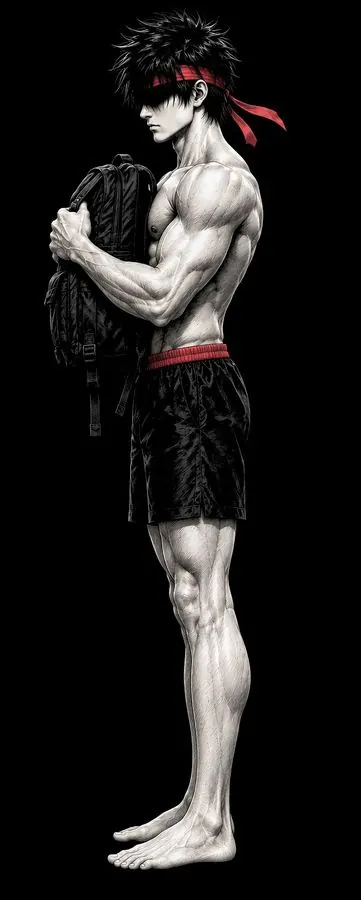
  2. Ryu standing tall, holding a weight against his chest
    Start
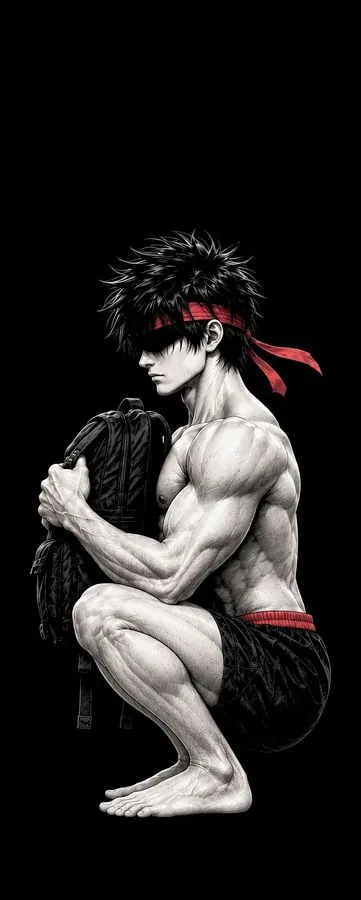
    Ryu in a deep squat, hips below his knees, holding the weight at his chest
    Finish

    02 · Quads · Glutes · Adductors

    Squat

    goblet with a dumbbell, or barbell once you've learned it

    • 4 × 8–15sets × reps
    • 2 minrest
    • RIR 1–2reps in reserve
    • Sit down between your heels until your hips are below your knees, heels flat, chest up.
    • Push the floor away. Knees follow your toes; don't let them cave in.

    HomeBackpack goblet squat. Hug a backpack loaded with books or water bottles.

    Study: Full squats grew the glutes +6.7% vs +2.2% for half squats. [Kubo et al. 2019]

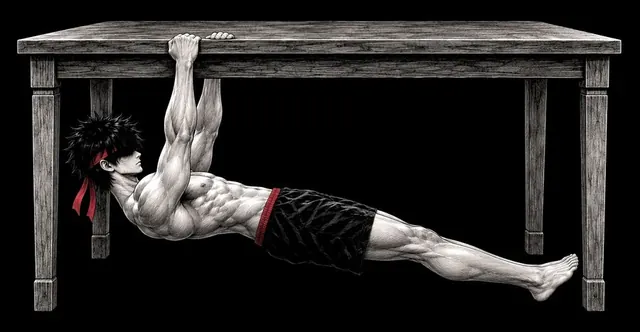
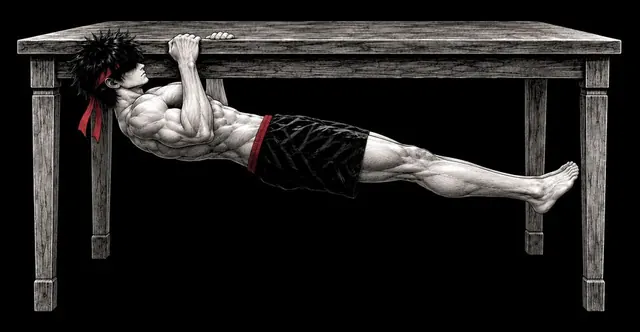
  3. Ryu lying under a table, arms straight, body straight from heels to shoulders
    Start
    Ryu pulling his chest up to the edge of the table
    Finish

    03 · Upper back · Lats · Biceps

    Inverted Row

    bar in a rack, or a sturdy table at home

    • 3 × 8–15sets × reps
    • 2 minrest
    • RIR 1–2reps in reserve
    • Body straight as a plank, heels on the floor, arms straight at the bottom.
    • Pull your chest to the bar or table edge, elbows back. Bend your knees to make it easier.

    HomeTable row. Only under a heavy table that can't tip: test it with your full weight first.

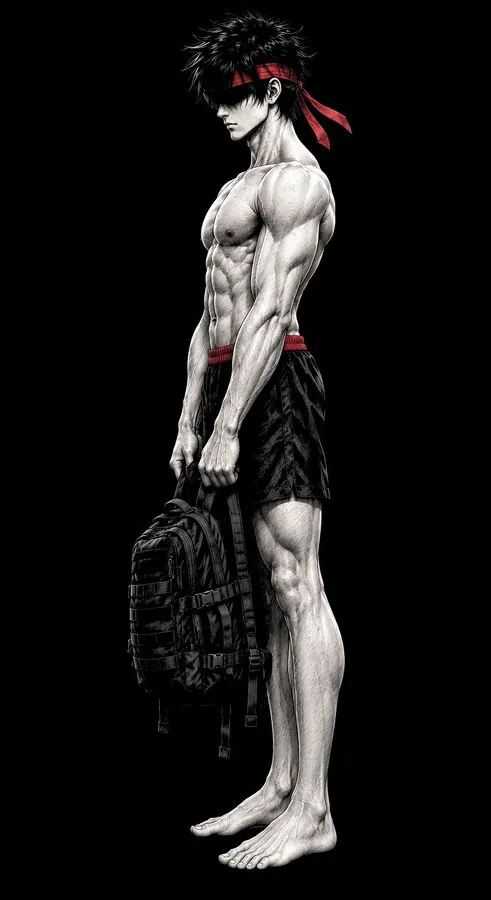
  4. Ryu standing upright, holding a loaded bag in front of his thighs
    Start
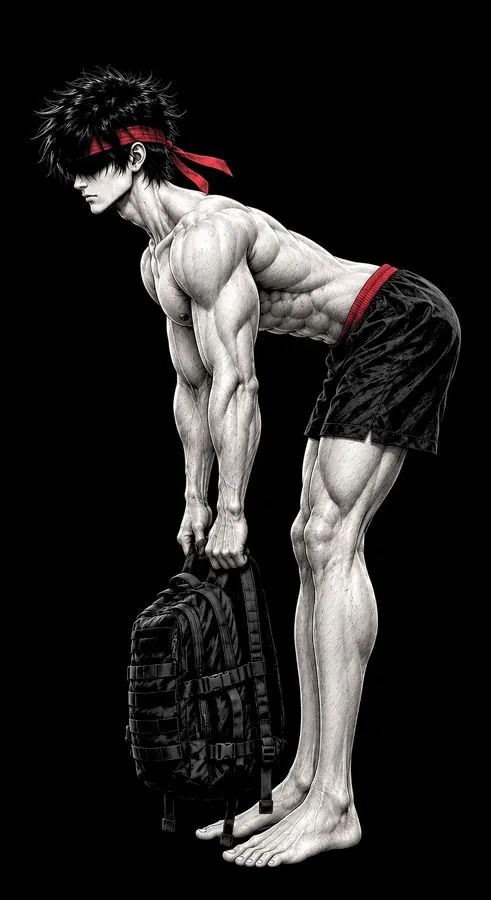
    Ryu hinged forward at the hips with a flat back, the bag near his shins
    Finish

    04 · Hamstrings · Glutes

    Romanian Deadlift

    dumbbells or barbell

    • 3 × 8–12sets × reps
    • 2 minrest
    • RIR 2reps in reserve
    • Soft knees. Push your hips back until you feel a strong stretch behind your thighs, back flat.
    • The weight slides close to your legs. Stand up by squeezing your glutes.

    HomeBackpack Romanian deadlift. Hold a loaded backpack by its straps, or one heavy bag in each hand.

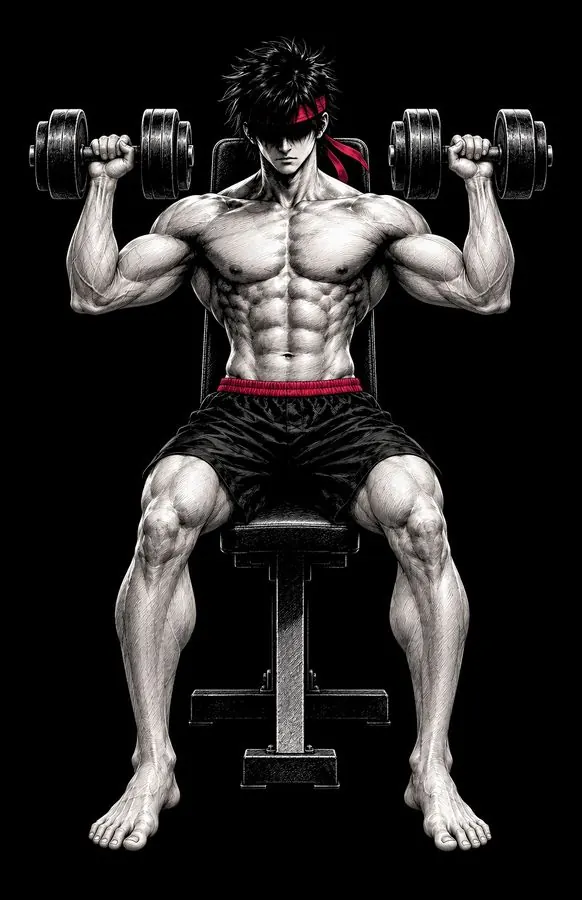
  5. Ryu seated on a bench with a back pad, dumbbells at shoulder height
    Start
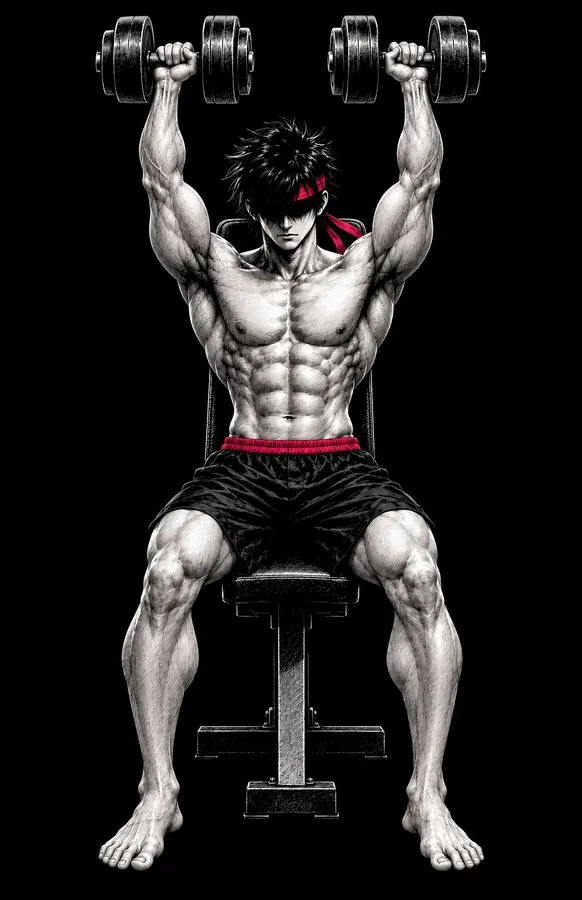
    Ryu seated, pressing both dumbbells overhead
    Finish

    05 · Front & side delts · Triceps

    Seated Dumbbell Shoulder Press

    bench with a back pad

    • 2 × 6–12sets × reps
    • 2 minrest
    • RIR 1–2reps in reserve
    • Back against the pad, dumbbells at shoulder height, forearms vertical.
    • Press until your arms are almost straight, lower to ear level under control.
    Ryu in a pike push-up, hips high, lowering his head toward the floor

    HomePike push-up. Hips high, lower the top of your head toward the floor in front of your hands. Feet on a chair to make it harder.

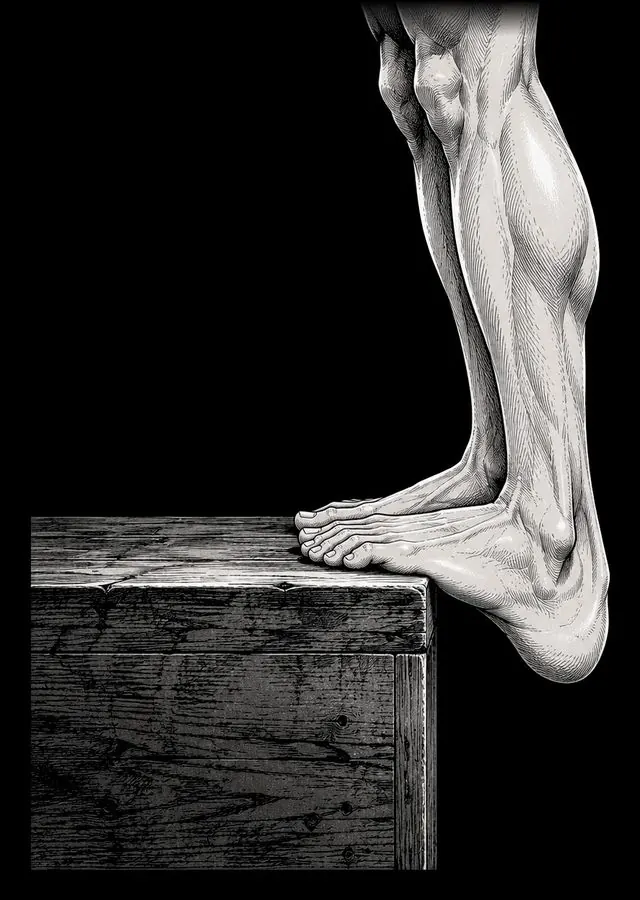
  6. Close-up of a heel lowered below the edge of a step in a deep calf stretch
    Start
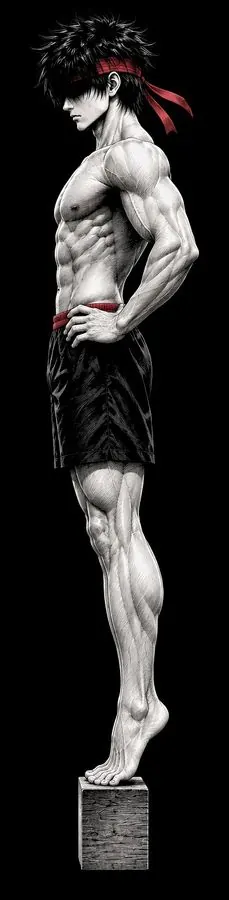
    Ryu standing on his toes on a block at the top of a calf raise
    Finish

    06 · Calves (gastrocnemius)

    Standing Calf Raise

    machine, step or stairs

    • 2 × 10–15sets × reps
    • 1 minrest
    • RIR 0–1reps in reserve
    • Knees straight. Lower your heels as far as they go and pause 1–2 seconds in the stretch. No bouncing.
    • Rise as high as you can on your toes.

    HomeOne-leg calf raise on a step. One hand on the wall for balance, the other holding a backpack.

    Study: Standing raises grew the gastrocnemius far more than seated ones (+12.4% vs +1.7%). [Kinoshita et al. 2023]

Notes

  • Use the home version of each exercise: backpack goblet squat, table row, backpack Romanian deadlift, pike push-up, one-leg calf raise on a step.
  • Push-ups: when you reach 20 clean reps on every set, move to the harder version (incline push-up, then push-up, then feet on a chair). Adding reps counts as progress too [Plotkin et al. 2022].
  • First two weeks: stop 3 reps short of failure and learn the moves.
Ryu in a deep squat, hips below his knees, holding a weight at his chest

Safety

Before you start

This is general fitness information, not medical advice. If you have pain, an injury or a health condition, check with a doctor or physical therapist first, and stop any exercise that hurts.

Under 18? Strength training is safe and worthwhile for teens when it is supervised and taught properly; most reported injuries came from poor technique, wrong loads or no supervision [Faigenbaum & Myer 2010] [Lloyd et al. 2014]. Learn the lifts with a coach, a PE teacher or an adult who knows them. Light weights first, no max lifts, never heavy weights over your head alone.

Questions people ask

What is Saitama's workout?

In One-Punch Man (manga Punch 11, Volume 2; anime season 1, episode 3), Saitama says he did 100 push-ups, 100 sit-ups, 100 squats and a 10 km run every day for three years, ate properly, and never used the air conditioner or the heater, to strengthen his mind.

Can the One Punch Man workout build muscle?

Push-ups and squats can build muscle when the sets are hard: push-ups taken near failure grew the chest +22% in 8 weeks [Kikuchi & Nakazato 2017]. But once 100 reps are easy, most of them are far from failure, and the routine has no pulling exercise. A harder, progressive version works better.

Should I do 100 push-ups every day?

You can, but it isn't needed. With the same weekly sets, training a muscle once or several times a week gave similar growth [Schoenfeld et al. 2019]. A few hard sets of push-ups, three times a week, with a harder version as you progress, follow what the studies show.

Is the Saitama workout good for beginners?

As a daily habit, it's a start. A beginner who can't do 100 push-ups yet should not force them: split the reps into sets, use an easier version (hands on a table) and stop 2–3 reps before failure for the first weeks. If you have pain or a health condition, check with a doctor first.
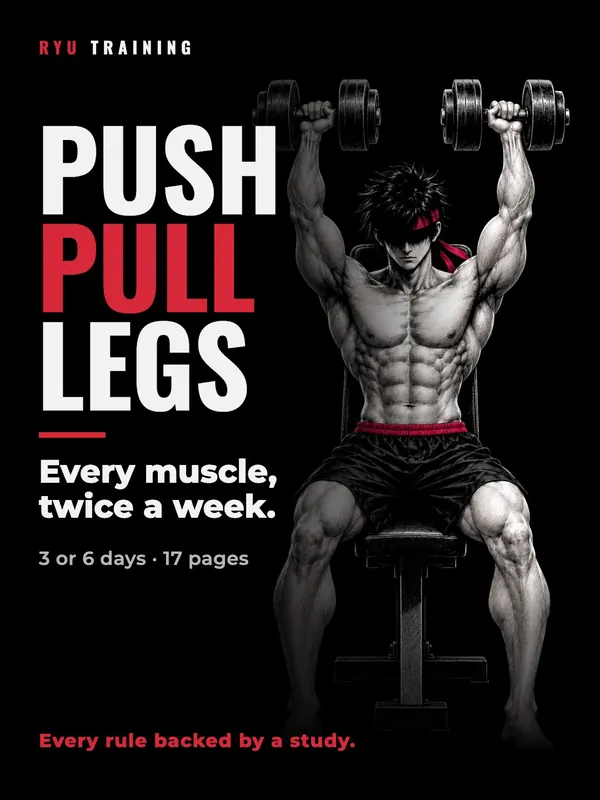
Cover of the free Push / Pull / Legs program PDF

Free PDF

Get the Push / Pull / Legs PDF

17 pages: every exercise drawn, with sets, reps, rest and effort, a warm-up, a progression guide and a 4-week training log. Every rule in it is backed by a study, with the references inside.

The download link appears right here; nothing is emailed to you. We keep your email and the program you chose to know who downloaded what, and we write to you only if you ticked the box. Privacy policy.

References

Every study below was checked on PubMed. Results in short, as the studies report them; most were done on young adults, often beginners.

  1. Faigenbaum AD, Myer GD (2010). Resistance training among young athletes: safety, efficacy and injury prevention effects. Br J Sports Med. PMID 19945973.Review: strength training is safe and worthwhile for teens when it is supervised and taught properly; most reported injuries came from poor technique, wrong loads or no supervision.
  2. Kikuchi N, Nakazato K (2017). Low-load bench press and push-up induce similar muscle hypertrophy and strength gain. J Exerc Sci Fit. PMID 29541130.18 untrained men, 8 weeks: push-ups grew the chest +22% vs +26% for a light bench press, and the triceps +10.5% vs +5.7% (table 1 of the full text).
  3. Kinoshita M et al. (2023). Triceps surae muscle hypertrophy is greater after standing versus seated calf-raise training. Front Physiol. PMID 38156065.14 beginners, 12 weeks: standing calf raises grew the outer gastrocnemius +12.4% vs +1.7% for seated ones; the soleus grew about the same (+2.1% vs +2.9%).
  4. Kubo K et al. (2019). Effects of squat training with different depths on lower limb muscle volumes. Eur J Appl Physiol. PMID 31230110.17 men, 10 weeks: full squats grew the glutes +6.7%, half squats +2.2%. The rectus femoris barely changed with either.
  5. Lloyd RS et al. (2014). Position statement on youth resistance training: the 2014 International Consensus. Br J Sports Med. PMID 24055781.International consensus, endorsed by sports-medicine and paediatric organisations, on how young people should strength train.
  6. Pelland JC et al. (2026). The Resistance Training Dose Response: Meta-Regressions Exploring the Effects of Weekly Volume and Frequency. Sports Med. PMID 41343037.67 studies, 2,058 people: more weekly sets meant more growth, with diminishing returns. Training a muscle more often added strength, but its effect on size was compatible with zero.
  7. Plotkin D et al. (2022). Progressive overload without progressing load? The effects of load or repetition progression on muscular adaptations. PeerJ. PMID 36199287.43 trained people, 8 weeks: adding reps at the same weight worked as well as adding weight.
  8. Refalo MC et al. (2023). Influence of Resistance Training Proximity-to-Failure on Skeletal Muscle Hypertrophy. Sports Med. PMID 36334240.Meta-analysis of 15 studies: no clear extra growth from going all the way to failure.
  9. Robinson ZP et al. (2024). Exploring the Dose-Response Relationship Between Estimated Resistance Training Proximity to Failure, Strength Gain, and Muscle Hypertrophy. Sports Med. PMID 38970765.Meta-regression: muscle growth tended to rise as sets ended closer to failure (exploratory).
  10. Schoenfeld BJ et al. (2019). How many times per week should a muscle be trained to maximize muscle hypertrophy?. J Sports Sci. PMID 30558493.25 studies: with the same weekly sets, training a muscle 1, 2 or 3+ times a week gave similar growth.