Leg training
How to grow legs: one exercise per muscle, each backed by a study
To grow your legs, train all four muscle groups, not only squats. Squats grew most of the quads, and deep squats the glutes and adductors, but in a 10-week MRI study neither depth changed the rectus femoris or hamstrings [Kubo et al. 2019]. Add leg extensions, seated leg curls and standing calf raises, and keep adding reps or weight.
Last updated · By Ryu Training, published by Badr Zinoun · How we wrote this
Which muscles do you need to train to grow your legs?
Four groups: the quads on the front of the thigh, the hamstrings on the back, the glutes, and the calves. The rectus femoris (one of the four quads) and most of the hamstrings cross both the hip and the knee, and squats load them less than you might think: in one MRI study, squats grew neither [Kubo et al. 2019].
| Muscle | Exercise | What the study found | Home version |
|---|---|---|---|
| Quads (vasti) | Squat | Knee extensors +4.9% with full squats and +4.6% with half squats in 10 weeks [Kubo et al. 2019] | Backpack goblet squat |
| Rectus femoris (front quad) | Leg extension | Grew the rectus femoris relatively more than the other quad muscles [Ema et al. 2013], in all three measured regions [Zabaleta-Korta et al. 2021] | Reverse Nordic |
| Hamstrings | Seated leg curl, 45° hip extension | Seated curls +14% vs lying curls +9% in 12 weeks [Maeo et al. 2021]; hip extensions grew the long head of the biceps femoris more than Nordics [Bourne et al. 2017] | Nordic curl |
| Glutes | Deep squat or hip thrust | +6.7% with full squats vs +2.2% with half squats [Kubo et al. 2019]; hip thrusts and squats grew them about the same [Plotkin et al. 2023] | Couch hip thrust |
| Calves | Standing calf raise | Outer gastrocnemius +12.4% standing vs +1.7% seated in 12 weeks [Kinoshita et al. 2023] | One-leg calf raise on a step |
Most of these studies lasted 8 to 12 weeks, in young adults, often beginners. The home versions come from our programs; the studies did not test them.
Do squats grow your whole legs?
No. In 17 men who squatted twice a week for 10 weeks, the knee extensors grew about 5% with full or half squats, but the rectus femoris and the hamstrings did not change in either group [Kubo et al. 2019].
Depth mattered for the glutes and adductors: they grew +6.7% and +6.2% with full squats, against +2.2% and +2.7% with half squats [Kubo et al. 2019]. Squats also grew the quads and adductors more than hip thrusts in 34 beginners [Plotkin et al. 2023]. Keep squats as the base of leg day, then fill the gaps.
How do you grow your quads?
Squat for most of the quads, and add a leg extension for the rectus femoris. Twelve weeks of leg extensions grew the rectus femoris relatively more than the other quad muscles [Ema et al. 2013]. In another trial, leg extensions grew all three measured regions of the rectus femoris, while Smith-machine squats mainly grew the middle of the vastus lateralis [Zabaleta-Korta et al. 2021].
You don't need to take every set to failure: stopping 1–2 reps short grew the quads as much as going to failure in 18 trained lifters over 8 weeks [Refalo et al. 2024].
How do you grow your hamstrings?
Use a leg curl and a hip extension, because squats did not grow them in the MRI study above [Kubo et al. 2019]. Seated leg curls, which work the hamstrings in a more stretched position, grew them +14% against +9% for lying leg curls in 12 weeks [Maeo et al. 2021].
On the hip side, 45° hip extensions grew the long head of the biceps femoris more than Nordic curls, and both grew the semitendinosus [Bourne et al. 2017]. At home, the Nordic curl is the one that needs no machine.
How do you grow your glutes?
Squat deep or do hip thrusts. Full squats grew the glutes about three times as much as half squats (+6.7% vs +2.2%) [Kubo et al. 2019], and in 34 beginners over 9 weeks, hip thrusts and squats grew the glutes about the same [Plotkin et al. 2023].
How do you grow your calves?
Do standing calf raises and spend time in the stretched bottom position. In 14 beginners over 12 weeks, standing raises grew the outer gastrocnemius +12.4% against +1.7% for seated ones, while the soleus grew about the same [Kinoshita et al. 2023].
In 42 young women, calf raises done in the stretched bottom half of the movement grew the inner gastrocnemius +15.2% against +6.7% for full range [Kassiano et al. 2023].
How many sets should you do for legs per week?
Enough hard sets per muscle that you recover from and can add to over time. More weekly sets meant more growth, with diminishing returns [Pelland et al. 2026], and once or twice a week both work when the weekly sets are the same [Schoenfeld et al. 2019]. Our three programs give the legs these numbers:
| Muscle | Push / Pull / Legs, Option A · 3 days | Push / Pull / Legs, Option B · 6 days | Upper / Lower, 4 days a week | 5-Day Split, 5 days a week |
|---|---|---|---|---|
| Quads | 7 | 14 | 8 | 8 |
| Hamstrings | 6 | 12 | 9 | 6 |
| Calves | 3 | 6 | 6 | 3 |
| Glutes | — | — | 3 + squats | — |
Direct hard sets per week. Presses also work your triceps and shoulders, rows and pull-ups your biceps, squats your glutes.
Rest about 3 minutes on squats and other big lifts: 3 minutes beat 1 minute for squat strength and thigh muscle thickness in trained men [Schoenfeld et al. 2016]. Light and heavy loads both built muscle when sets ended close to failure [Schoenfeld et al. 2017], so leg extensions, curls and calf raises can stay at 10–15 reps.
What does a leg day that trains all four look like?
This is the Legs day of our Push Pull Legs program: a squat and a hip hinge first, then one exercise each for the quads, the hamstrings and the calves. The Upper Lower Split spreads the same work over two lower days and adds a hip thrust.
| Exercise | Sets × reps | Rest | RIR |
|---|---|---|---|
| Squat Home: Backpack goblet squat | 3 × 6–10 | 3 min | 2 |
| Romanian Deadlift Home: Backpack Romanian deadlift | 3 × 8–10 | 2–3 min | 2 |
| Leg Press Home: Bulgarian split squat | 2 × 10–12 | 2 min | 1–2 |
| Seated Leg Curl Home: Nordic curl | 3 × 10–12 | 1–2 min | 0–1 |
| Leg Extension Home: Reverse Nordic | 2 × 12–15 | 1 min | 0–1 |
| Standing Calf Raise Home: One-leg calf raise on a step | 3 × 10–15 | 1 min | 0–1 |
Legs day of the Push / Pull / Legs program: Quads · Hamstrings · Glutes · Calves, 60–70 min. RIR = reps in reserve, the clean reps you could still do when you stop the set.
Keep the same weight until you reach the top of the rep range on every set, then add the smallest step. Adding reps at the same weight worked as well as adding weight [Plotkin et al. 2022].
Safety
Before you start
This is general fitness information, not medical advice. If you have pain, an injury or a health condition, check with a doctor or physical therapist first, and stop any exercise that hurts.
Under 18? Strength training is safe and worthwhile for teens when it is supervised and taught properly; most reported injuries came from poor technique, wrong loads or no supervision [Faigenbaum & Myer 2010] [Lloyd et al. 2014]. Learn the lifts with a coach, a PE teacher or an adult who knows them. Light weights first, no max lifts, never heavy weights over your head alone.
Watch
The video
How To Force Your Legs To Grow
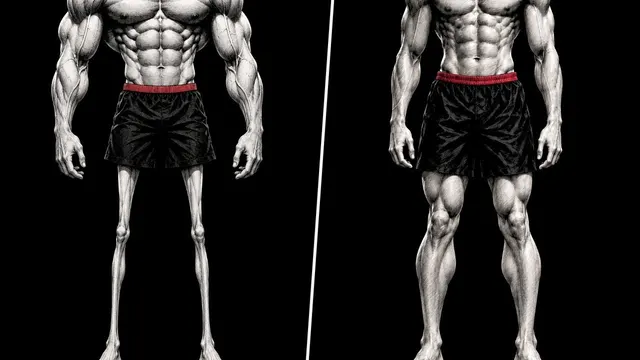
Squats are the king of leg day, but they miss one muscle in the front and almost the whole back. Your legs are four muscle groups: here's how to grow all four, with one rule that ties them together. Every claim comes from a study (sources below).
Questions people ask
Can you grow legs without squats?
Yes. Hip thrusts grew the glutes as much as squats in 34 beginners, though squats grew the quads and adductors more [Plotkin et al. 2023]. Leg extensions grew the rectus femoris [Zabaleta-Korta et al. 2021] and seated leg curls the hamstrings [Maeo et al. 2021], two muscles squats did not grow in one MRI study [Kubo et al. 2019].
How often should I train legs?
Once or twice a week. With the same weekly sets, training a muscle 1, 2 or 3+ times a week gave similar growth [Schoenfeld et al. 2019]. Twice a week, as in the Upper / Lower plan, keeps each leg session shorter.
Why are my legs not growing?
Common reasons: squats only (they did not grow the rectus femoris or the hamstrings in one study [Kubo et al. 2019]), too few hard sets [Schoenfeld et al. 2017], or the same weight and reps for months [Plotkin et al. 2022]. People also respond very differently: on one 12-week arm program, size changes ranged from −2% to +59% [Hubal et al. 2005].