Workout splits
Best workout split for muscle growth: PPL vs upper lower vs full body
The best workout split for muscle growth is the one you can repeat every week with enough hard sets. With equal weekly sets, split and full-body routines built the same muscle [Ramos-Campo et al. 2024], and training a muscle 1, 2 or 3+ times a week gave similar growth [Schoenfeld et al. 2019]. Pick by the days you can train.
Last updated · By Ryu Training, published by Badr Zinoun · How we wrote this

Which workout split is best for muscle growth?
No split wins on its own. What builds muscle is the number of hard sets each muscle gets per week: across 67 studies, more weekly sets meant more growth, with smaller gains for each set added, while training a muscle more often added strength but had an effect on size compatible with zero [Pelland et al. 2026].
So the job of a split is to fit enough hard sets into the days you really have. An earlier meta-analysis of 15 studies put the effect at about 0.37% more growth for each extra weekly set [Schoenfeld et al. 2017].
| Split | Days a week | Each muscle trained | Typical week | Watch out for | Free program |
|---|---|---|---|---|---|
| Full body | 3 | 3 times a week | Mon, Wed, Fri: the whole body each time | Long sessions once you need more sets per muscle | Not on this site yet |
| Upper / lower | 4 | Twice a week | Upper, Lower, rest, Upper, Lower | Needs 4 free days every week | Upper Lower Split |
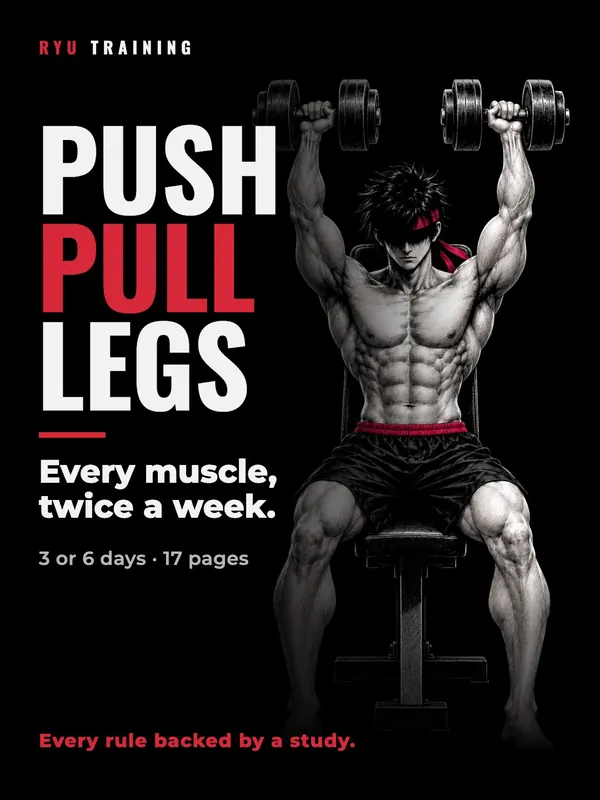
| Push / pull / legs | 3 or 6 | Once a week (3 days) or twice (6 days) | Push, Pull, Legs, then repeat | 6 days a week to train each muscle twice | Push Pull Legs |
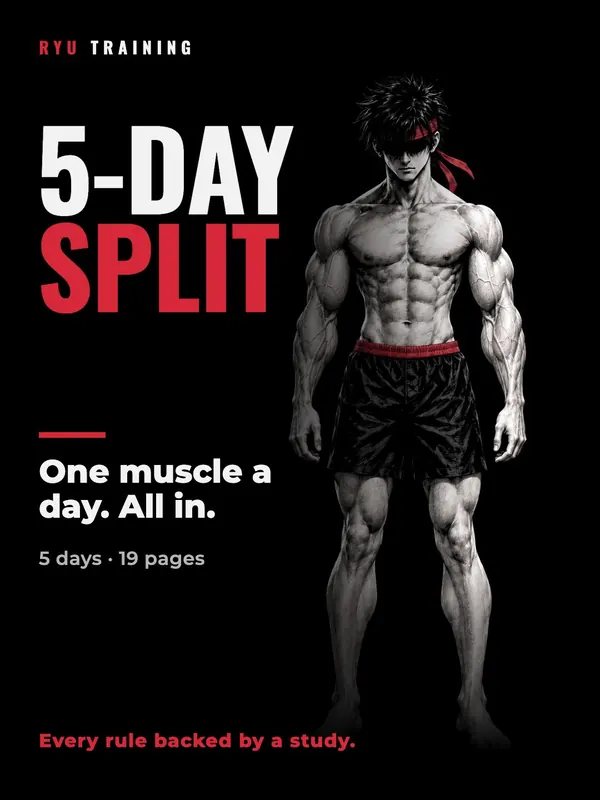
| 5-day (bro) split | 5 | Once a week | Chest, Back, Shoulders, Arms, Legs | A missed day means that muscle waits two weeks | 5-Day Split |
Is full body better than a split?
No, not when the weekly sets are equal. A 2024 meta-analysis of 14 studies (392 people) found the same strength and muscle gains with split and full-body routines, and its authors concluded that people can pick a routine by personal preference [Ramos-Campo et al. 2024].
One study points the other way: in 20 trained men over 8 weeks, a 3-day total-body routine grew the elbow flexors more than a once-a-week split, with similar strength gains [Schoenfeld et al. 2015]. That is one small study, against a meta-analysis that pooled 14.
Full body suits 3 days a week. This site has no full-body program yet; the closest is the Upper Lower Split, which also trains every muscle twice a week.
PPL vs upper lower: which is better?
Neither builds more muscle by itself; they differ in days and frequency. Upper / lower trains each muscle twice in 4 days. Push pull legs trains each muscle once in 3 days, or twice in 6.
Is twice a week better than once? An early meta-analysis said yes [Schoenfeld et al. 2016]. A later one with 25 studies found no difference once the weekly sets were equal, and concluded that you can choose a frequency by preference [Schoenfeld et al. 2019]. Twice a week mostly makes it easier to fit more sets without very long sessions, as the table below shows.
| Muscle | Push / Pull / Legs, Option A · 3 days | Push / Pull / Legs, Option B · 6 days | Upper / Lower, 4 days a week | 5-Day Split, 5 days a week |
|---|---|---|---|---|
| Chest | 5 | 10 | 7 | 10 |
| Back | 8 | 16 | 11 | 12 |
| Shoulders | 6 | 12 | 5 | 8 |
| Rear delts | 3 | 6 | — | 3 |
| Triceps | 5 | 10 | 4 | 6 |
| Biceps | 5 | 10 | 4 | 6 |
| Quads | 7 | 14 | 8 | 8 |
| Hamstrings | 6 | 12 | 9 | 6 |
| Calves | 3 | 6 | 6 | 3 |
| Glutes | — | — | 3 + squats | — |
Direct hard sets per week. Presses also work your triceps and shoulders, rows and pull-ups your biceps, squats your glutes.
At 6 days, Push Pull Legs option B runs the option A sessions twice and doubles every number: it is the next step, not a different program.
How many days a week should I train?
As many as you can repeat every week without skipping. With the weekly sets equal, training a muscle 1, 2 or 3+ times a week gave similar growth [Schoenfeld et al. 2019], so let your calendar pick the split:
- 3 days: Push Pull Legs, option A, or a full-body routine.
- 4 days: the Upper Lower Split.
- 5 days you never skip: the 5-Day Split.
- 6 days, once 3 days a week feel easy to keep: Push Pull Legs, option B.
If your week changes a lot, avoid the 5-day split: with one session per muscle, a missed day means that muscle waits two weeks.
What matters more than the split?
Three things decide your results on any split:
- Hard sets. Stop 1–2 reps short of failure: in 18 trained lifters, that grew the quads as much as going to failure [Refalo et al. 2024].
- Progress. Beat your log: adding reps at the same weight worked as well as adding weight over 8 weeks [Plotkin et al. 2022].
- Time. On the same 12-week arm program, biceps size changed from −2% to +59% between people [Hubal et al. 2005]. Judge a split after months, against your own log.
Safety
Before you start
This is general fitness information, not medical advice. If you have pain, an injury or a health condition, check with a doctor or physical therapist first, and stop any exercise that hurts.
Under 18? Strength training is safe and worthwhile for teens when it is supervised and taught properly; most reported injuries came from poor technique, wrong loads or no supervision [Faigenbaum & Myer 2010] [Lloyd et al. 2014]. Learn the lifts with a coach, a PE teacher or an adult who knows them. Light weights first, no max lifts, never heavy weights over your head alone.
Questions people ask
Is a bro split bad for muscle growth?
No. With the same weekly sets, split and full-body routines gave the same muscle gains in a meta-analysis of 14 studies [Ramos-Campo et al. 2024]. Its weak point is the schedule: miss a day and that muscle waits two weeks.
What is the best workout split for beginners?
One you can repeat every week. Our pick is Push Pull Legs, option A: 3 days a week, each muscle once, about an hour per session. Move to 6 days once you've trained for 8 weeks without missing sessions.
Is training 6 days a week better than 3?
Only if the extra days add hard sets you recover from. More weekly sets meant more growth, with diminishing returns, while frequency on its own had an effect on muscle size compatible with zero [Pelland et al. 2026].
Can I switch splits?
Yes. A new split changes your calendar, not the rules: keep about the same weekly hard sets per muscle and keep adding reps or weight [Plotkin et al. 2022].